
 Helpline:
 ہیلپ لائن:


















Blog
Out-of-School Children in Pakistan: A Silent Crisis Demanding Immediate Action
9 جولائی 2026
In Pakistan, the crisis of out-of-school children has reached alarming proportions, signaling a national emergency with profound human and economic consequences. Despite Article 25-A of the Constitution, which guarantees free and compulsory education for all children aged 5–16 years, Pakistan remains among the top three countries globally with the highest number of out-of-school children (OOSC).
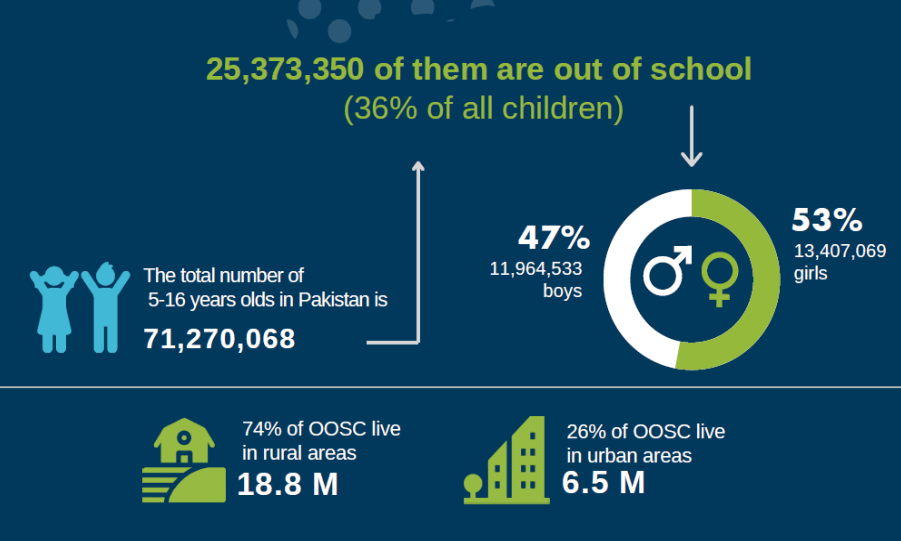
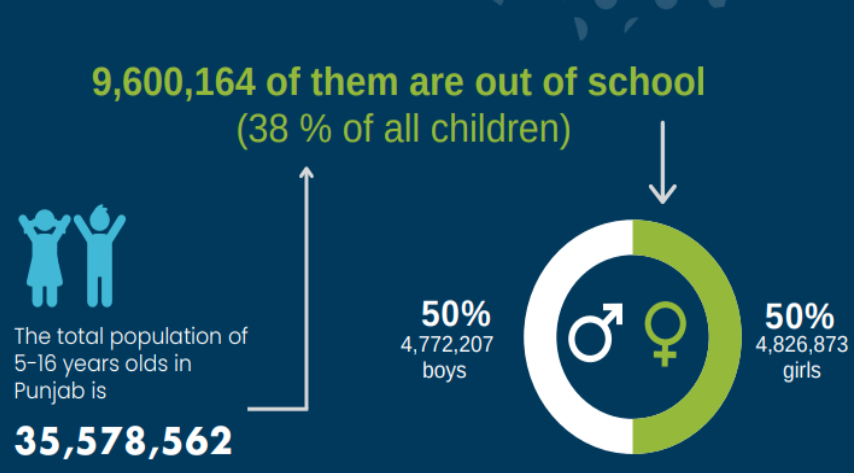
According to the 2023 Population Census, an estimated 71.2 million children fall within the 5–16 age group. Of these, approximately 25.3 million, nearly 36%, are not in school. In Punjab alone, around 9.6 million children (38%) are out of school. The disparities are even starker in other regions: in Sindh, 46% of all children, including 52% of girls, are out of school; in Balochistan, the figure rises to 58%1. The COVID-19 pandemic has further exacerbated this crisis, pushing even more children and adolescents out of school, many of whom are unlikely to return to school.
This is not merely an education crisis; it is a development emergency. The lack of access to quality education, coupled with misalignment between skills and market needs and weak school-to-work transitions, has left millions of young people unprepared for a rapidly evolving job market shaped by globalization, digitalization, and climate change.
The Cost of Inaction
Education is a cornerstone for achieving all Sustainable Development Goals (SDGs) and serves as a catalyst for economic and climate resilience. Investing in education yields immense long-term benefits, while failure to act has devastating financial repercussions. According to UNESCO, “every US$1 spent on education increases GDP by an average of $20. Educated individuals earn higher wages, with each additional year of schooling increasing annual earnings by 9%2. In addition, UNESCO reports that “investing $1 in youth skills can yield a fifteen-fold return in economic growth3”.
In 2020, Pakistan spent 2.1% of its Gross Domestic Product (GDP) on education, below the South Asian regional average of 2.9% and the global average of 4.3%. Alarmingly, this figure decreased to 1.5% in 2023. Such a low investment is insufficient to fulfill the constitutional pledge to provide free and compulsory education to children aged 5–16. The consequences of this underfunding are evident in the country’s high numbers of out-of-school children (OOSC), learning poverty, and stunted economic growth. Pakistan needs to reassess its approach to education financing, broaden its revenue base, and gradually increase its education expenditure to at least 4.3% of GDP, ensuring access to quality education for all4.
Understanding the Drivers of the OOSC Crisis
Pakistan’s net enrolment rates in primary and middle school stand at 60% and 37%, respectively, with Punjab performing slightly better at 70% and 41%5. These figures, coupled with high dropout rates, 50% nationally and 33%6 in Punjab, highlight severe challenges in retaining students in the education system.
The factors behind school dropout and non-enrolment can be broadly categorized into three domains7:
- Systemic Barriers
These include the absence of accessible formal education options, inadequate infrastructure, undertrained teachers, and limited non-formal education (NFE) alternatives. The education system often lacks bridges between basic education and vocational training, leaving adolescents with no viable pathways back into learning.
- Social and Cultural Norms
Deep-rooted societal beliefs, particularly regarding gender roles, disproportionately affect girls. In conservative communities, girls’ education is often viewed as a low-return investment, while boys are seen as future breadwinners. Girls may be kept at home to preserve family honour, care for siblings, or early marriage. Low maternal education levels and unsafe school environments further contribute to dropout rates.
- Economic Pressures
For many families, children’s contributions to household income through informal labour outweigh the perceived benefits of schooling. Additionally, the lack of visible economic return from education, due to irrelevant curricula and weak job prospects, discourages continued enrolment. These perceptions are grounded in reality: current education systems often fail to equip students with the job-ready skills they need, thereby reinforcing cycles of poverty and exclusion.
A Four-Pronged Strategy: From Exclusion to Economic Empowerment
To reverse this crisis, Pakistan must adopt an integrated, four-pronged strategy that links access to education with economic opportunity. These approaches must not only address the structural reasons why children are out of school but also build toward a future where young people are equipped to contribute meaningfully to the economy.
1. Non-Formal Education (NFE): Plugging the Access Gap
In underserved regions, schools are often absent, inaccessible, or ill-equipped. Community-based learning centres can serve as a lifeline, especially for girls, by providing flexible, inclusive environments tailored to adolescent learners. These centres should be locally managed, ensuring cultural sensitivity and community ownership.
They must deliver not only basic literacy and numeracy but also life skills, digital fluency, and financial literacy. Returning learners often require psychosocial support and a curriculum that aligns with their real-life aspirations and goals. Integrating digital tools, incentives such as meals and health check-ups, and gender-responsive infrastructure (e.g., female instructors, safe spaces) can significantly improve enrolment and retention.
Importantly, strong linkages with the formal education system are essential. NFE should not be a dead-end, but a pathway back to formal education or certified skills training. Without this foundational access, efforts to build skills will remain inaccessible, especially for girls who have been out of school the longest.
2. Skills Development: Building Demand Aligned Capacities
Education alone cannot prepare youth for the labour market unless it is aligned with economic needs. Skills development programmes must be redesigned to match market demands, segmented by age and ability. A one-size-fits-all model is inadequate for addressing the diverse realities of adolescent learners.
Younger adolescents (11–13 years) should receive pre-vocational or school reintegration support to build foundational competencies and reintroduce them to structured learning. For older adolescents (14–19 years), especially those unlikely to return to formal schooling, targeted technical and vocational training is essential. This training must align with sectors that have growth potential and can absorb young workers, such as construction, clean energy, agri-tech, digital services, and sustainable manufacturing.
Soft skills, such as teamwork, communication, and problem-solving, should be embedded in all training modules. For individuals aged 18 and above, industry-aligned training and apprenticeships can facilitate a smoother transition from school to work. When industries co-design curricula and provide hands-on experience, youth gain both technical and practical competencies.
3. Job Placement and Entrepreneurship: Closing the Loop
Skill-building is futile without clear employment pathways. Structured support for career counselling, job placement, and employer engagement must be institutionalized. Too often, vocational programs end without follow-up, leaving graduates unsupported.
Career guidance should begin early, providing young people with insights into various professions, labour market trends, and actionable career paths. Partnerships with local businesses can facilitate internships and job-shadowing that demystify the world of work.
Entrepreneurship should also be encouraged, particularly in areas with limited formal employment. Business skills training, access to microfinance, digital marketing tools, and ongoing mentorship can empower youth, especially girls, to start and grow their ventures. Supporting both employment and self-employment can expand economic participation across rural and peri-urban areas.
4. From Fragmentation to Integration: A Systemic Response
Piecemeal efforts cannot resolve a crisis of this magnitude. For too long, education, skills development, and employment initiatives have operated in silos with minimal coordination, fragmented delivery, and unaligned outcomes. What is needed now is an integrated, multi-sectoral response that unites government, donors, the private sector, civil society, and local communities around a shared vision of inclusive and sustainable development.
This includes harmonizing data systems to track progress more effectively, aligning curricula and certification standards across delivery models, and coordinating funding streams to reduce duplication. Introducing outcome-based financing can further incentivize results-driven approaches. Education and skills should no longer be treated as isolated interventions but as components of a continuous, connected learning-to-livelihood pathway.
Government leadership is essential in setting policy direction and scaling proven models. However, this must be complemented by meaningful private sector engagement, particularly in shaping training that meets real labour market needs. Civil society plays a vital role in community mobilization, awareness-raising, and safeguarding, especially for vulnerable groups such as girls, children with disabilities, and marginalized rural populations. Donors and development partners must also shift from funding short-term, fragmented projects to enabling long-term, systemic transformation.
Learning from the Region
Success stories from South Asia show that transformation is possible. Bangladesh’s BRAC Non-Formal Primary Education model reintegrated over 10 million out-of-school children (OOSC) through community schools, resulting in a 30% reduction in dropout rates among rural girls. India’s Kasturba Gandhi Balika Vidyalaya helped 75% of enrolled girls transition to formal education or vocational training. These models underscore the power of context-sensitive, gender-responsive, and scalable solutions.
Policy Recommendations
To address the out-of-school children crisis effectively, Pakistan must implement bold and targeted policy actions. First, a national program should be launched to integrate non-formal education with skills training and job placement, creating a seamless learning-to-livelihood pathway for out-of-school children. Provincial governments must be mandated to allocate at least 25% of their education budgets to non-formal education (NFE) linked with skills training, thereby expanding access in underserved areas. Additionally, legislation should require that at least 50% of technical and vocational education and training (TVET) programs be delivered in partnership with the private sector, ensuring alignment with real labor market needs. To ensure accountability and maximize impact, outcome-based financing models should be adopted, tying public and donor funding to tangible results such as student reintegration and skills acquisition. These concrete measures, if implemented systematically, can transform the education and skills landscape and contribute significantly to Pakistan’s inclusive growth agenda.
A Call to Action
The crisis of out-of-school children is urgent but solvable. We can no longer afford delay. Every year, millions of children remain disconnected from opportunity, and Pakistan loses out on innovation, productivity, and inclusive growth.
This is our chance to correct market failures, promote gender equity, and empower Pakistan’s youth to drive economic transformation. We must be bold in our vision, united in our approach, and steadfast in our resolve.
Let us build the bridge from exclusion to opportunity with urgency, equity, and a long-term vision for national prosperity. The time to act is now.